
Sydney Musings With Ian Tran, The Art Of Shaping A City One Sign At A Time
 Eloise Luke
Deputy Editor (Local Markets) | Urban List

Sydney Musings is an original local series of intimate conversations tracing Sydney's creative undercurrent and exploring the enduring exchange between a city and the people inspired by it.
The human eye is instinctively drawn to good design. You don’t need to call yourself an expert to know when something feels cool, interesting or attractive. As you wander Sydney's streets, the venues that capture your attention rarely do so by accident. More often, they're the product of countless design decisions working below the level of conscious though, subtly guding your eye and inviting you inside.
Enter Ian Tran of Domus Vim: the designer quietly shaping many of those first impressions, and the creative single-handedly dominating Sydney’s hospitality signage scene right now.
“I never set out with Domus Vim to become a placemaking company,” Ian tells me.
“But inherently, by making signage, you are physically changing the landscape of the city—one sign at a time.”
As a child, Ian grew up playing tennis, drawing (in his words, not very well—though I’m inclined to see this as an act of humility), and watching anime in Sydney’s western suburbs, specifically the Auburn/Bankstown area.
It’s an area he still feels connected to, even though he lives in the city these days. If he’s not travelling west, you’ll probably find him in Surry Hills, specifically at Sang by Mabasa, drinking soup.
On a typical workday, however, Ian Tran is rarely still. When I call him, he’s just left an install and is walking through the city to check out new sites. Every day varies, he assures me. Domus Vim is still very much a one-man show, so he’s often doing everything himself.
“There’s a little bit digital, I have to do the drawings and all that,” he shares.
“I say ‘we’ a lot, but you can change that to ‘I’. I think I do it as a defence mechanism.”
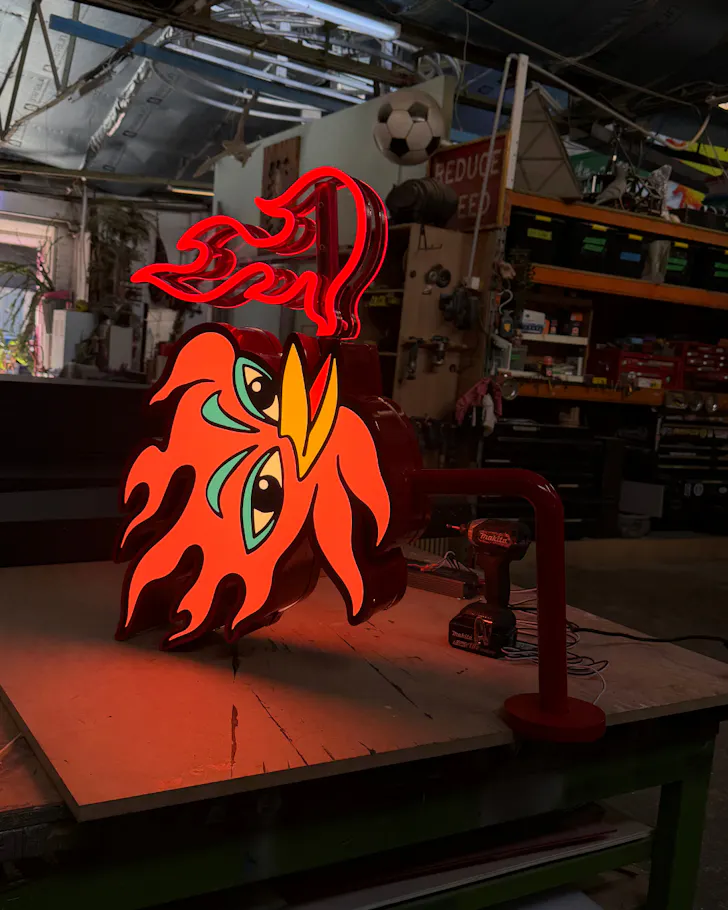
Domus Vim in its current form is all about objects, signage and design for hospitality and culture. You may not know Ian’s name, but you’ll likely recognise his work: his signage marks the local doorways of Incu, A.P Bakery, Shadow Baking, Bar Planet, Fabbrica and many more. But the business didn’t always look like this.
“Domus Vim was originally not owned by me. In my second year of uni, I was approached by them for an internship at what it was at the time: an architectural model-making company, specialising in making small-scale models for developers and architects, using tools like laser cutters and whatnot,” Ian reflects.
“I was asked to come on board as a laser cutting technician. It was really random.”
He pauses to laugh. “I was working at EB Games at the time, and my resume pretty much goes from EB Games straight into Domus Vim for the last 13 years. So it’s a terrible resume, but I’m not getting another job.”
His retelling is characteristically grounded but it’s difficult not to be impressed. At just 20 years old, while still completing his architecture degree, Ian took over the company when the owner (his partner at the time) decided to step away. Now the sole owner of a business that didn’t quite reflect his interests, Ian saw an opportunity to reshape it.
“I started gearing the business towards my interests in my 20s. I was young, going out in the city, that meant I was doing sound installations, stage installation or design,” he reminisces.
“We eventually landed in restaurants because I guess I like eating out. I spend a lot of my time in restaurants outside of work, so it makes sense to be working in a field that I’m passionate about as well.”
With years immersed in hospitality design, he’s watched the industry shift and expand in countless ways.
“I think Sydney restaurants are a great example of what happens when you can tie in all the different design industries into one space,” he tells me.
“We’ve moved beyond the classic white linen tables, and there’s a focus on everything—from the fit-outs to artworks on the wall to the branding. Sydney is very good at creating a restaurant space that really amplifies what the food they’re cooking is.”
And yet, he speaks just as passionately about restraint, not just in venues, but in his own process.
“Before, through complexity, we were trying to hide the things that we couldn’t show,” he explains.
“But the materials that we work in are so beautiful. You don’t need much to create something nice.”
That philosophy extends to his approach to signage, which is often deeply informed by context: streetscape, architecture, and the feel of a building before a single letter is installed.
“The signs that blend into the landscape are often the most beautiful, even though the point is to capture attention. You have to build to what you’re looking at,” Ian reflects.
“Signage is a great archival piece as well. It’s imbued with the history of the restaurants that they’re in while they’re there, and maybe for a long time after.
“Those pieces have stories. They sat on the street for so long. It might sound weird, but they’ve seen some things.”
When we turn to Sydney’s broader creative landscape, Ian lights up at the mention of emerging talent; designers who care deeply about craft and detail.
“Sydney’s having its little glow-up, I guess. Or maybe I’m just getting older and seeing it all differently. I feel like I’m outside of the fishbowl now, so I can see in.”
The humility creeps back into his tone when I ask how he sees his own work from that vantage point.
“If I meet someone on the street, I just say I make signs for restaurants. That dumbs it down quite a bit, but it’s the easiest,” he considers.
“Domus Vim has been very hard to explain because it’s moulded throughout all the things that I’ve wanted to do. At heart, I’m a maker. But at the moment, I’m just a sign guy.”
Like many of us in a city that rewards fast-paced hustle, Ian craves the quiet that comes with hovering over a bowl of soup in a small restaurant. But he’s not quite ready to slow down.
“I’ll definitely be in signage and hospitality for a while. But Domus Vim will continue to evolve as it has over the last decade, pursuing what I’m interested in."
"I’d like to open a potato chip company—I’d like a desk and an air-conditioned office,” he decides.
“The dream is to slow down, but I don’t think that’s in me. It’s going to continue at this speed until… I don’t know, the chip company comes or something.”
We laugh at that—an unexpected dream for someone who has quietly shaped Sydney’s streetscape for over a decade. But as he reminds me, this kind of design rarely announces itself.
“Even though it might not be spoken about much, it’s always there, and we’re always looking at it even if we don’t want to.”
And perhaps that’s the real takeaway: to look twice at your surroundings. We live in a city shaped by extraordinary creative minds. Even something as simple as the sign above your favourite bar or bakery might be the product of someone’s life’s work, influencing the way you move through the world—and that is something worth noticing.
Love the series? Read on for how local filmmaker Hyun Lee is finding solace in Asian grocers.
Image credit: Ian Tran | Supplied